Teacher Handwriting Fonts for Print
There is a particular style of handwriting that most people recognise immediately. It is the writing that appeared on the board at the front of the classroom: upright, even, clearly formed, with no unnecessary flourishes and no ambiguity about which letter is which. It is not beautiful in the way that calligraphy is beautiful. It is useful, which is its own kind of quality.
Teacher-style print fonts replicate this handwriting. They are designed to be copied rather than admired, to model the correct form of each letter without distracting the learner with stylistic complexity. For anyone creating handwriting worksheets for classroom use, for early learners, or for learners who need maximum clarity, they are the natural starting point.
This article covers print fonts only. For cursive, see Teacher Cursive Handwriting Fonts.
What Defines a Good Print Font for Classroom Use
Letterform clarity
Every letter should have one clear correct reading, with no strokes that could be misread or that require interpretation. The lowercase a should use the single-storey form. The g should be open rather than closed at the bottom. The l should be a plain vertical with no flourish at the foot that might be confused with an i or a 1.
Generous proportions
The x-height, which is the height of the body of lowercase letters, should be relatively large compared to the ascenders and descenders. This makes the letters easy to see and easy to copy, and it produces a worksheet that reads clearly even at smaller print sizes.
Consistent stroke weight
There should be no thick-thin contrast of the kind found in calligraphic or serif fonts. Every stroke in the font should be the same weight, matching what a standard pen will produce in the hand.
Neutral character
The font should have no strong personality of its own. A teacher-style font should not compete for attention with the content of the worksheet. It should recede and let the letterforms speak.
Complete character sets
A classroom font needs to cover the full alphabet in upper and lowercase, numbers, and common punctuation. Fonts designed for display use often have gaps that only become apparent when generating a full practice sheet.
Entry and Exit Strokes: To Include or Not
One of the decisions that divides teacher-style print fonts is whether to include entry and exit strokes. These are the small lead-in and lead-out marks at the beginning and end of each letter that prepare the hand for joining later on.
Some handwriting schemes, particularly those that introduce joining early, use fonts with these strokes from the start. The argument is that learning letter formation with the joining strokes in place makes the transition to joined writing smoother, because the hand has already learned the movements. Other schemes use plain print letterforms without strokes in the early stages, on the grounds that the additional complexity is unnecessary at the point of first learning.
If your curriculum specifies an approach, follow it. If you are creating general-purpose materials, plain letterforms without entry strokes are the safer default for early learners. The strokes can be introduced once the basic letterforms are secure.
Regional Differences: Choosing the Right Style
Letterforms vary by country and sometimes by curriculum. What is considered the standard school hand in England differs from the standard in Australia, the United States, or France, and using a font that does not match the expected style can create confusion for young learners who encounter different forms from their teacher and on their practice sheet.
The two major print handwriting systems in the United States are D'Nealian and Zaner-Bloser. In England, the National Curriculum specifies upright letters with entry strokes. Australia varies by state. This regional variation is worth understanding before choosing a font, and is one of the main reasons the Playwrite family is worth knowing about in detail.
General-Purpose Print Fonts
These fonts are not tied to a specific national curriculum but are reliable, clearly formed, and appropriate for most general classroom use.
Andika
Andika was designed specifically for literacy and reading acquisition. The letterforms are upright, simply formed, and entirely unambiguous. It uses a single-storey a, a clean g, and consistent proportions throughout. It works particularly well for learners who need maximum clarity, including ESL learners and those with reading difficulties.

Best for: Early letter formation, ESL learners, learners who need maximum letterform clarity.
ABeeZee
ABeeZee was created specifically for young children learning to read and write. The letterforms are large, clear, and simple, with a friendly quality that works well for early learners. Like Andika, it uses single-storey letterforms throughout and keeps the stroke logic unambiguous.

Best for: Reception and KS1 materials, early letter formation.
US Curriculum Fonts
D'Nealian
D'Nealian is one of the most widely used handwriting systems in the United States. Developed in the 1970s, it uses a slightly slanted, simplified letterform designed to bridge the gap between print and cursive: the letters have small tails and entry strokes that prepare the hand for joined writing later.
The system has its advocates and its critics. Supporters argue that the continuous stroke approach reduces the adjustment needed when children transition to cursive. Critics note that the slant and the added strokes can make the print stage harder to learn, since the letterforms are more complex than simple upright manuscript letters.
Fonts in this style include the licensed D'Nealian Handwriting font and several third-party alternatives. The KG font family includes options that reflect D'Nealian characteristics and are widely used by American teachers.
Zaner-Bloser
Zaner-Bloser uses upright, simple manuscript letterforms with no added tails or slant. The letters are more visually distinct from cursive than D'Nealian, but many educators find them easier to teach and learn at the print stage because the forms are simpler and more consistent.
Zaner-Bloser has its own licensed font family. For teachers working within this system, using the official font ensures the model matches exactly what is being taught in class.
KG Primary Fonts
The KG font family from Kimberly Geswein is one of the most widely used resources for American classroom teachers. It includes dozens of fonts across a range of styles, with several variants featuring educational features such as dashed centres, arrow guides, and dotted outlines.
KG Primary Penmanship and its variants offer clean, consistent letterforms in a style that reflects common American handwriting instruction. In the worksheet generator on this site you can pick KG TC (KG Teacher Created) directly, and its dotted tracing style uses the matching dashed version of the font.
KG fonts are free for personal and classroom use but require a commercial licence for products sold for profit.
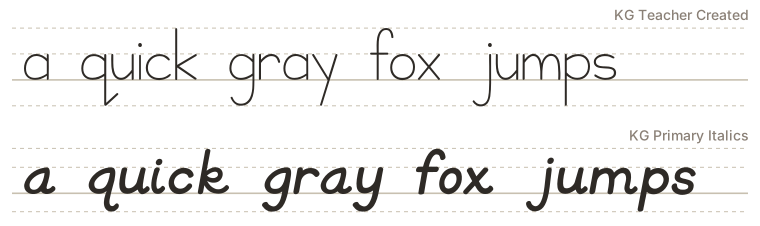
Best for: US classroom contexts, tracing worksheets, curriculum-aligned resources.
UK Curriculum Fonts
Sassoon Primary
Sassoon Primary is one of the most respected educational fonts in the UK and is widely used in British primary schools. It was designed by Rosemary Sassoon based on research into how children learn to write, with particular attention to the exit strokes that prepare letters for joining.
It is a licensed font and is not available for free download, but it is worth knowing about if you are creating materials professionally or for a school that uses it as its standard. The letterforms are clean, well-researched, and widely recognised in the UK educational context.
Nelson Handwriting
Nelson Handwriting is another widely used licensed font designed for the UK National Curriculum. Like Sassoon, it models upright letterforms with the entry and exit strokes specified by the curriculum. It is most commonly found in schools that use the Nelson handwriting scheme.
French Curriculum: Ecolier
France does things differently from English-speaking countries: children learn an upright joined cursive, with tall loops on the ascenders and descenders, as their main handwriting from the first years of school. The school model font for France is therefore a cursive one, not a print one.
Ecolier is a French school cursive font and one of the few freely available fonts that models this hand accurately. It is available directly in the worksheet generator on this site.
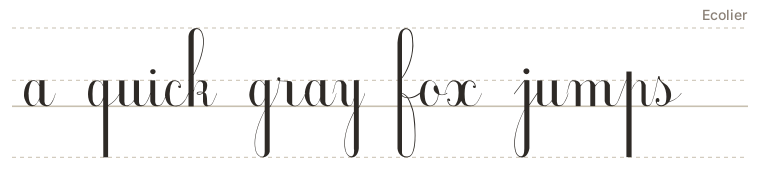
The existence of Ecolier also points to a broader principle worth stating clearly:
Handwriting instruction is highly regional, and a font that is correct for one country may model the wrong letterforms for another. If you are creating materials for an international audience, this is something to address explicitly rather than assume away.
Playwrite: Curriculum-Matched Fonts for 40 Countries
The Playwrite collection, created by TypeTogether and available free through Google Fonts, is the most thorough solution available for curriculum-matched handwriting fonts. Unlike general-purpose fonts that model a broad style, each Playwrite variant was built to reflect the specific letterforms used in a particular national curriculum, based on the Primarium research project, a study of handwriting instruction methodologies across Latin-based languages.
For teachers creating worksheets, this matters practically. A font that matches the handwriting model a child is being taught in school removes a source of confusion that most educators do not realise exists. When the practice sheet uses different letterforms from those taught in class, the child has to reconcile two models instead of reinforcing one.
Note that most Playwrite variants model the joined or semi-joined hand a country teaches, not plain print. For unjoined print practice, the closest is Playwrite DE Grund, the German print script described below.
How the regional variants differ
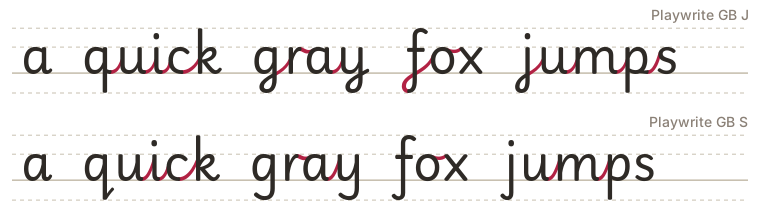
England (Playwrite GB J / Playwrite GB S). Two variants cover the joined and semi-joined styles used in English schools, broadly corresponding to different handwriting schemes. The semi-joined variant is closer to what many UK schools teach in the early stages before full joining is introduced.
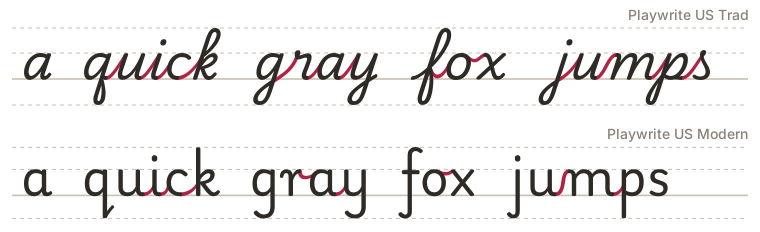
United States (Playwrite US Trad / Playwrite US Modern). The traditional variant follows the looped cursive long taught in American schools, while the modern variant is a simpler joined hand with fewer loops.
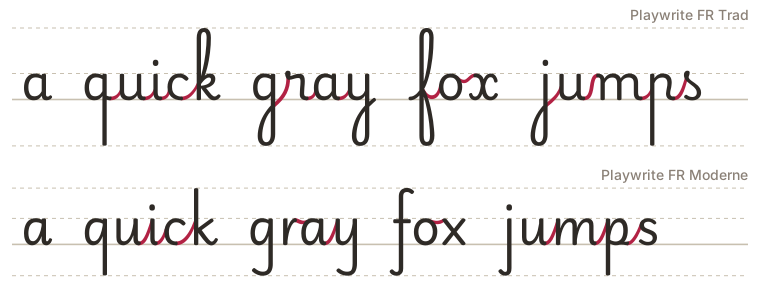
France (Playwrite FR Trad / Playwrite FR Moderne). French schools teach an upright joined cursive from the start. This tradition also spread to Spain, Portugal, Italy, and their former colonies in Latin America, where it remains the standard teaching model. Both a traditional variant, with tall loops, and a simpler modern variant are available.
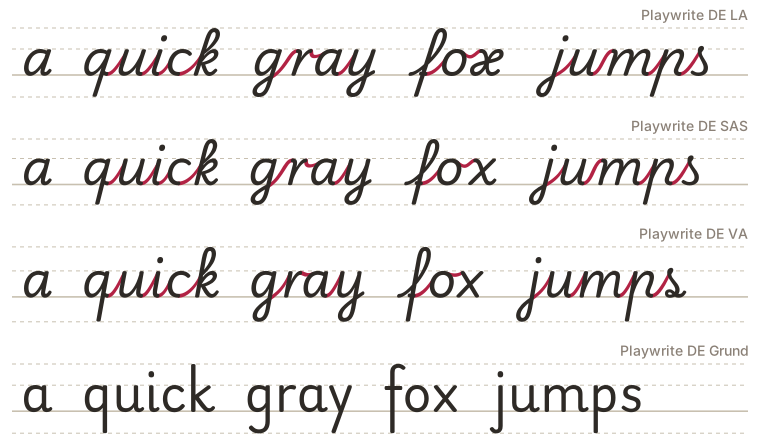
Germany (Playwrite DE LA / DE SAS / DE VA / DE Grund). Handwriting education in Germany is regulated at the state level, with most states using one of three cursive-based styles: Lateinische Ausgangsschrift, Vereinfachte Ausgangsschrift, or Schulausgangsschrift. Some states also permit Grundschrift, a progressive approach that uses print script with cursive exit strokes rather than full joined writing. Playwrite provides a separate variant for each of these models.
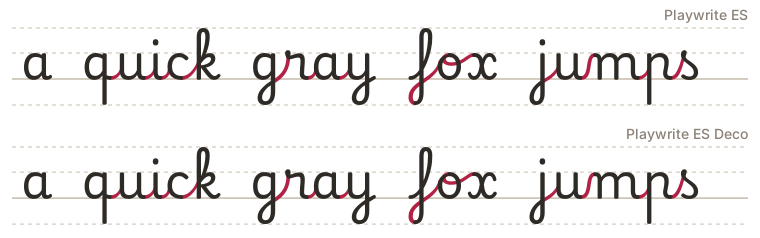
Spain (Playwrite ES / Playwrite ES Deco). Spanish primary handwriting typically features a hybrid style with joined lowercase and simplified print uppercase, or a more traditional fully cursive style with ornate capitals. The two variants cover both approaches.
The Guides versions
Each Playwrite variant has a corresponding Guides version, which adds the four standard handwriting guide lines to every line of text: baseline, midline, ascender line, and descender line. These allow teachers to type any content and turn it directly into a printable practice sheet with the correct structural reference lines already in place, with no additional design effort required.
Every Playwrite variant can be used in the worksheet generator, joins included. The generator draws its own guide lines, so the Guides versions are not needed there.
Using Print Fonts in the Worksheet Generator
The worksheet generator includes several fonts specifically selected for classroom use, including Andika, ABeeZee, Ecolier, KG TC, and several Playwrite variants. These can be accessed through the teachers variant of the generator, which sets larger default font sizes, more generous line spacing, and guide line styles suited to classroom practice.
For early learners working on letter formation, a four-line guide with midline, baseline, ascender, and descender lines gives the clearest visual structure. For older learners working on consistency and proportion, a simple baseline or standard ruled line is usually enough.
Font size is worth considering when creating resources for young children. A larger letter size gives more room for the hand to work and makes the model easier to see and analyse. For early letter formation work, a larger size is almost always preferable to a smaller one.
A Note on Font Licensing
For personal classroom use and printing for your own students, most educational font licences permit use without additional payment. Where licensing becomes relevant is in sharing materials digitally, distributing them through platforms, or creating commercial worksheet packs.
Google Fonts, including the Playwrite and Andika families, are licensed under the Open Font Licence, which permits free use including in printed and distributed materials. The KG fonts permit free personal and classroom use but require a commercial licence for products sold for profit. Licensed fonts such as Sassoon and Zaner-Bloser have their own terms, which are worth checking if you are distributing materials at scale.