Teacher Cursive Handwriting Fonts
Cursive instruction is more regionally varied than print instruction, and the stakes of choosing the wrong font are higher. A child learning to join letters is internalising not just shapes but movements: the sequence of strokes, the angle of entry into each join, the way the pen lifts or does not lift between letters. A font that models incorrect or inconsistent joins does not just look different from what is taught in class; it actively teaches the wrong movements.
This article covers the fonts that are appropriate for teaching and practising cursive handwriting, with particular attention to curriculum alignment and regional differences. For print fonts, see Teacher Print Handwriting Fonts.
The Transition from Print to Cursive
Before choosing a cursive font, it is worth understanding where cursive fits in the learning sequence, because this affects which font is right for your learners.
Most handwriting schemes introduce print letterforms first, then add exit strokes to prepare letters for joining, then introduce full joined writing. The point at which joining begins varies by scheme and by country. In some systems, children begin learning joins in Year 2 or Grade 2. In others, joining is not introduced until later, or is left as an individual preference into secondary school.
A font designed for the transition stage, where children are learning their first joins, should be different from one designed for a learner who already writes joined handwriting and is working on fluency and style. The transition font should have simple, predictable joins and clear entry and exit strokes. The fluency font can have more character, because the foundational movements are already in place.
What Makes a Font Right for Cursive Instruction
Consistent, correct joins
The joins between letters should be consistent throughout the font, and they should reflect how joins are actually taught rather than how they look when drawn by a type designer for aesthetic purposes. Many popular cursive fonts have joins that are visually appealing but would require unnatural pen movements to replicate, or that vary between letters in ways that make the underlying logic hard to learn.
Legibility at practice-sheet scale
Cursive fonts are often designed at display size and can become harder to read at the smaller sizes used on practice sheets, particularly if the joins are elaborate or the letterforms have heavy calligraphic contrast. A good teaching font holds up clearly at practice-sheet scale.
Appropriate slant
Most cursive instruction uses a forward slant, typically between 52 and 75 degrees from horizontal. The exact angle varies by curriculum. A font that matches the slant taught in class removes one variable from an already complex learning task.
Regional correctness
Cursive joining conventions differ significantly between countries. A font that models correct joins for the UK curriculum may model incorrect joins for a French or German learner. This is covered in detail in the regional sections below.
Fonts for Learning Cursive
These fonts are appropriate as direct copying models for learners who are being introduced to joined writing. They prioritise consistency and correctness over stylistic character.
Edu NSW ACT Cursive
Edu NSW ACT Cursive was developed for the New South Wales and ACT Australian curriculum and is one of the few freely available fonts that models correct, simple joins throughout. The letterforms are clear, the join logic is consistent, and the overall style is neutral enough to serve as a solid foundation without imposing a strong regional character.
It is the most accessible starting point for cursive instruction in the Google library. The joins are simple and predictable, which makes it appropriate for learners at the beginning of the joining stage. A child who practises against this font is building the right movements from the start.

Best for: Beginners learning joined writing, children being introduced to cursive, general-purpose cursive instruction.
Playwrite (Cursive Variants)
The cursive variants of Playwrite are the most pedagogically rigorous free cursive fonts available. Each variant was built to reflect the specific joining conventions of a national curriculum, based on the Primarium research project. This means the joins are not just visually consistent; they are correct for the learner's educational context.
The joins work in the worksheet generator on this site too: choose a Playwrite cursive variant and the sheet shows correctly joined words, ready to trace.
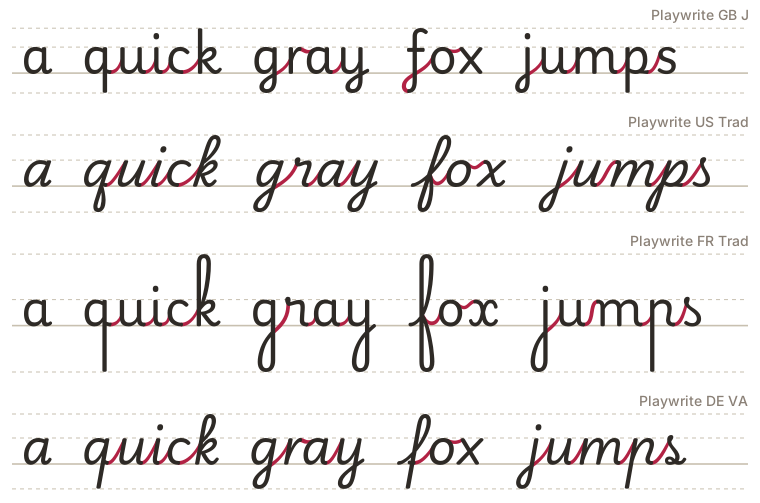
Best for: Curriculum-aligned cursive instruction, learners where a specific national model is required.
Regional Differences in Cursive Instruction
Cursive joining conventions vary more between countries than print conventions do. The following sections cover the major regional differences that affect font choice.
England and Wales
The National Curriculum in England specifies that children should be taught to write with joined letters, using exit strokes that lead naturally into the next letter. The style is typically a forward-slanting joined hand with consistent entry and exit strokes.
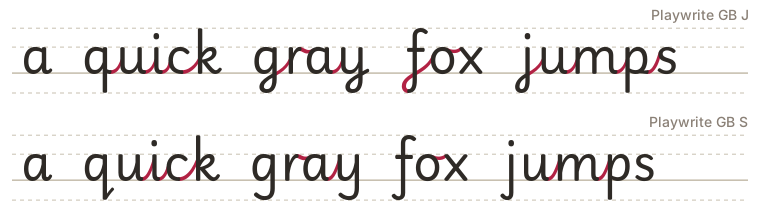
Playwrite GB J models the fully joined style, while Playwrite GB S covers the semi-joined approach used in the earlier stages of instruction by many schools. Licensed options include fonts associated with major UK handwriting schemes such as Sassoon Joined and Nelson Joined Italic.
United States
Cursive instruction in the United States is not nationally mandated and varies significantly by state and district. The two most common systems are D'Nealian cursive and Zaner-Bloser cursive, each with its own joining conventions and associated licensed fonts. Some states have moved away from mandatory cursive instruction entirely, while others have reintroduced it in recent years.
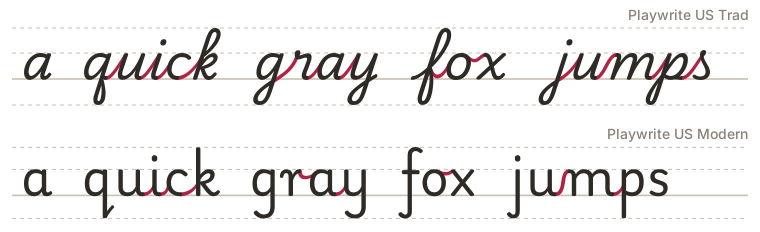
For teachers in states where a specific system is mandated, the official fonts associated with that system are the right choice. For general-purpose cursive materials, Edu NSW ACT Cursive provides a clean neutral model, and Playwrite US Trad covers the traditional American cursive conventions.
France, Spain, and Latin America
Cursive handwriting instruction in France uses an upright style rather than the forward slant common in English-speaking countries. The letters sit vertically on the baseline, and the joins are typically simple and continuous. This upright cursive tradition also spread to Spain, Portugal, Italy, and their former colonies in Latin America, where it remains the standard teaching model.
Playwrite FR Trad and Playwrite FR Moderne cover the traditional and modern French curriculum variants respectively. For Spanish-speaking contexts, Playwrite ES and Playwrite ES Deco cover the two main approaches used by Spanish educational publishers.
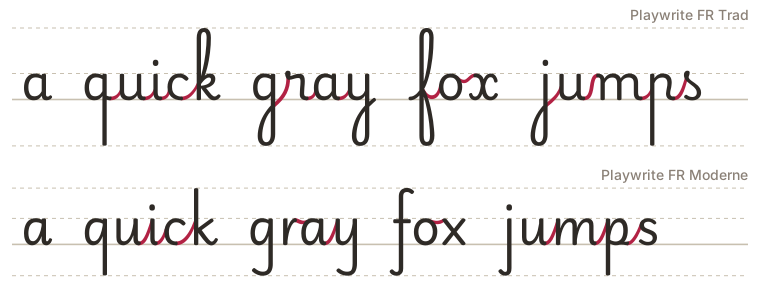
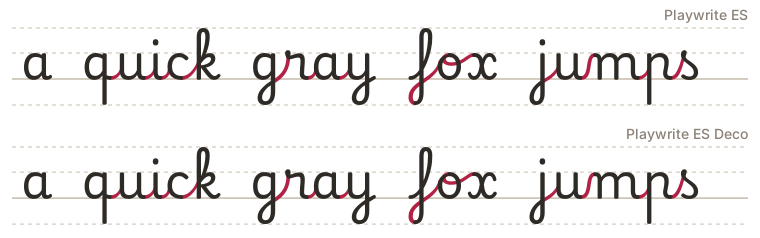
For teachers working with learners whose educational background is in this tradition, the upright slant is important: a forward-slanting cursive font will not match the model the learner was taught, and the mismatch is more significant than it might appear on the page.
Germany and Austria
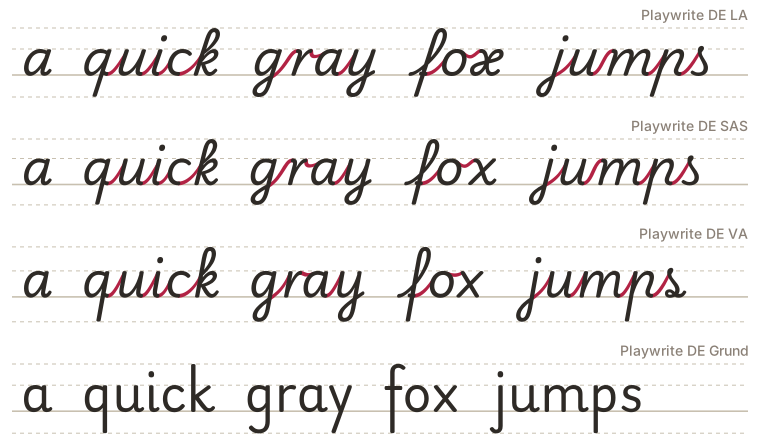
Germany presents one of the most complex pictures in cursive instruction because handwriting education is regulated at the state level. Most states use one of three styles: Lateinische Ausgangsschrift, Vereinfachte Ausgangsschrift, or Schulausgangsschrift. Some states also permit Grundschrift, a progressive approach that uses print script with cursive exit strokes rather than full joined writing.
Playwrite DE LA, DE SAS, and DE VA cover the three main styles respectively. For teachers creating materials for German-speaking learners, identifying which state and which scheme applies is the essential first step before choosing a font.
Australia
Australia varies by state, with each having its own handwriting curriculum and associated fonts. New South Wales uses the style modelled by Edu NSW ACT Cursive, which is available on Google Fonts. Victoria, Queensland, and Western Australia each have their own styles and associated resources.
For Australian teachers, the state curriculum is the starting point. Playwrite AU NSW covers the New South Wales style, and other Playwrite Australia variants cover additional state models.
Fonts for Cursive Style Development
The fonts in the previous sections are appropriate as learning models. The fonts below are not suitable as models for learners who are still building their joining technique, but they are genuinely valuable for older learners or adults who already write joined handwriting and are working on developing a more personal, characterful style.
The distinction matters for classroom use: these fonts are appropriate for style-focused practice with older students, but should not be used as the primary model for anyone still learning the mechanics of joined writing. Inconsistent joins, stylised loops, and letterforms drawn for visual appeal rather than reproducibility are common in this category, and practising against them at the foundational stage builds habits that are difficult to unlearn.
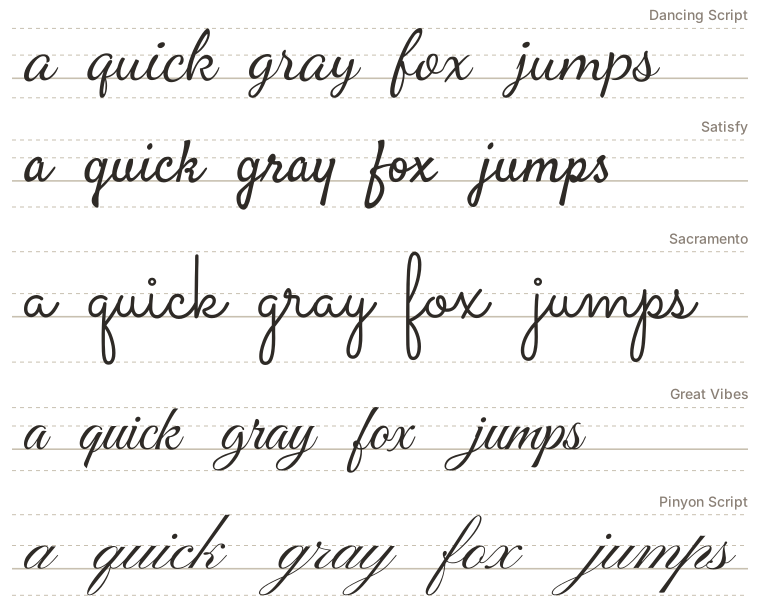
Dancing Script is the most accessible of these, with clear joins and a natural forward lean that makes it a reasonable style reference for intermediate learners. Satisfy sits at a slightly more formal point on the spectrum and rewards careful study for learners working toward a polished personal style. Sacramento, Great Vibes, and Pinyon Script are best treated as aspirational references rather than copying models: the thick-thin stroke contrast they display is produced by a broad-nib pen and cannot be replicated with a standard ballpoint or gel pen.
For all of these, the most productive approach is to pair them with a simpler learning font. Use Edu NSW ACT Cursive or the relevant Playwrite variant for the drilling work, and use the style fonts as reference material for the aesthetic you are working toward.
Using Cursive Fonts in the Worksheet Generator
The worksheet generator supports cursive fonts for practice sheet generation, with the caveat about Playwrite joins noted above. For general cursive practice, Dancing Script and Satisfy both render well in the generator and produce clean, legible sheets.
For slant-guided practice, the generator allows you to set a slant angle that matches the curriculum you are working with. A forward slant of around 52 to 60 degrees is appropriate for most English-language cursive instruction. For French and Spanish upright cursive, a near-vertical setting of 80 to 90 degrees is more appropriate.
Row spacing is worth adjusting for cursive fonts. The prominent ascenders and descenders in most cursive styles require more vertical space between lines than print fonts, and tighter spacing will cause strokes to run into adjacent lines on a printed sheet.
A Note on Font Licensing
Most curriculum-specific cursive fonts, including the official D'Nealian, Zaner-Bloser, Sassoon Joined, and Nelson Joined Italic fonts, are licensed. For personal classroom use and printing for your own students, most licences permit use without additional payment. Commercial distribution of materials using these fonts requires checking the specific terms.
Google Fonts cursive options, including Edu NSW ACT Cursive and all Playwrite variants, are licensed under the Open Font Licence, which permits free use including in printed and distributed materials.