Best Google Fonts for Handwriting Practice Worksheets
Google Fonts is the first place most people look when building handwriting practice materials, and for good reason. The library is free, the fonts load reliably, and there are enough options to cover almost any learner or use case. The problem is that the library was not designed with handwriting practice in mind, and most of the fonts in it were not either.
This matters more than it might seem. A font that looks like handwriting is not the same as a font that teaches handwriting well. Most of the popular handwriting-style fonts in the Google library were designed for aesthetic appeal: they look warm and personal on a poster or a greeting card. But the irregularity, the stylised letterforms, and the deliberate quirks that make them charming as display fonts make them poor models for a learner who is trying to internalise correct letter formation. Copying an inconsistent model builds inconsistent habits.
This guide separates the fonts that are genuinely good practice models from the ones that are best used as style inspiration, and explains the difference clearly so you can choose the right tool for what you are actually trying to achieve.
One distinction worth understanding before you start: some fonts are appropriate for direct copying practice, where the goal is to replicate each stroke correctly. Others are better used as style references, where the learner is studying qualities like slant, rhythm, and overall character rather than copying letterform by letterform. Both are valid uses. This guide covers both and flags which category each font belongs to.
What to Look for in a Google Font for Practice
Before getting to the list, it helps to understand what separates a genuinely useful practice font from one that only looks good on screen.
The most important thing is letterform consistency. Every instance of the same letter should be built from the same strokes, in the same order, with the same proportions. If the font's letters vary in ways a hand cannot control or predict, the learner is copying noise rather than a model.
The second is stroke logic. A good practice font makes it clear where each stroke starts, where it ends, and how it connects to the next. Learners are not just copying shapes; they are learning movements. A font with ambiguous entry and exit points teaches the shape but not the motion.
The third is the lowercase a. A font that uses a single-storey lowercase a, the simple circle-with-a-downstroke form, is almost always a better practice font than one that uses a two-storey a. The two-storey form is standard in most body text fonts because it reads well in long text, but it is harder to reproduce by hand and is not how most people are taught to write the letter. A single-storey ‘a’ is a strong signal, but not a guarantee for a good handwriting practice font. It could still have poor stroke logic or spacing.
The Best Google Fonts for Print Handwriting Practice
Playwrite DE Grund
Playwrite is a family of handwriting fonts developed in collaboration with national handwriting curricula from many countries, so the letterforms are not just clean; they are pedagogically correct. Stroke order, entry points, exit strokes, and letter proportions all reflect how handwriting is actually taught.
Most Playwrite variants model joined handwriting, and they are covered in the cursive section below. The one closest to plain print is Playwrite DE Grund, based on Grundschrift, the German print script: unjoined letters with small exit strokes that prepare the hand for joining later.

Best for: Children learning to write for the first time, anyone who wants to practise against a pedagogically correct model.
Andika
Andika was designed specifically for literacy and reading acquisition, which makes it one of the more carefully considered fonts in the Google library for educational use. The letterforms are simple, open, and consistent. The lowercase a is single-storey, the counters are generous, and nothing in the font competes with the letter shapes for attention.
It is slightly more neutral in character than Playwrite, without the curriculum-specific stroke guidance, but for straightforward print practice it is an excellent and reliable choice.

Best for: Children in the early stages of letter formation, ESL learners, anyone who needs a clean and unambiguous print model.
ABeeZee
ABeeZee was created specifically for young children learning to read and write. The letterforms are large, clear, and simple, with an open and friendly quality that works well for early learners. Like Andika, it uses single-storey letterforms throughout and keeps the stroke logic unambiguous.
The x-height is generous, which helps at the sizes typically used on practice sheets, and the overall consistency makes it a sound model for foundational letter formation work.

Best for: Young children, early years and KS1 classroom resources.
Didact Gothic
Didact Gothic takes a slightly more neutral, typographic approach than ABeeZee or Andika, but the letterforms remain simple and consistent enough to work well as a print practice model. It has a clean, modern quality that makes it a good choice for older children or adult learners who find more obviously child-oriented fonts off-putting.
It does not have the warm, hand-drawn quality of some other fonts in this guide, but that restraint is a strength for practice purposes. The less personality a practice font has, the more clearly it communicates the underlying letterform.

Best for: Older children, adults who want a clean print model without a childlike aesthetic.
Comic Neue
Comic Neue is a more consistent, refined reinterpretation of Comic Sans, retaining its informal and approachable feel while reducing some of the irregularities that made the original unsuitable as a practice model. The letterforms are generally clear and use single-storey forms, which makes the font easier to reproduce than most casual handwriting styles.
That said, it is not a pedagogically rigorous handwriting model. Stroke construction is not always explicit, and proportions can vary slightly in ways that are acceptable for reading but less ideal for learning precise letter formation. Learners practising exclusively with Comic Neue may still develop inconsistencies that need correcting later.
Used selectively, it can be helpful as a softer, less formal alternative to stricter practice fonts, particularly for children who respond better to a more relaxed visual style. It works best as a secondary option alongside a more structured model such as Playwrite or Andika, rather than as a primary teaching font.

Best for: Supplementary practice, informal worksheets, learners who benefit from a less rigid aesthetic. Not recommended as a primary model for foundational handwriting.
Patrick Hand and Handlee: Use with Caution
Patrick Hand and Handlee are both clean, legible fonts with a natural handwritten feel. They are among the more popular choices for handwriting worksheets, and it is easy to see why: they look like the kind of careful, considered everyday handwriting many people aspire to.
The caution is this: that handwritten quality comes precisely from the subtle irregularities and personal quirks built into the letterforms. Those qualities make the fonts feel warm and authentic, but they also make them imperfect models. Handwriting is not taught to look like Patrick Hand or Handlee. It is taught from consistent, neutral letterforms, and style develops later through practice and individual habit.
Both fonts are better suited to adult learners who already have correct formation and are working toward a more personal style, rather than to children or beginners who are still building the foundations.
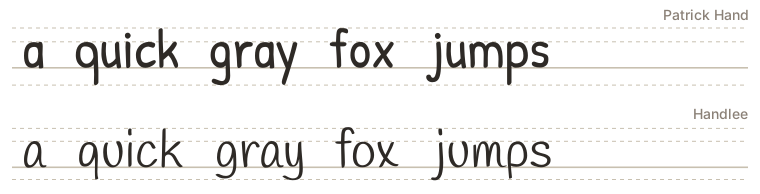
Best for: Adults developing personal handwriting style, style-focused practice. Not recommended for foundational learning.
The Best Google Fonts for Cursive Practice
The same principle that applies to print fonts applies here with even more force. Most cursive and script fonts in the Google library were designed to look beautiful, not to model correct joined handwriting. Inconsistent joins, stylised loops, and letterforms that prioritise visual elegance over reproducibility are common. If the goal is to develop fast, fluid cursive handwriting, learning from a font like this will work against you: the movements it teaches do not scale to natural writing speed, and the joins it models are not how a pen actually moves across a page.
The two google fonts mentioned below stand out as genuine learning models, but before heading into those, a gentle word of caution:
Stroke order
Fonts can show letter shapes and joins, but they cannot indicate how letters are actually formed by the hand. They can model letter shapes and joins, but they do not indicate how each letter is actually formed by the hand. In cursive especially, the sequence and direction of strokes matter as much as the final appearance, because they determine whether writing becomes fluid and efficient or slow and effortful. A learner can trace a word that looks correct while still using incorrect movement patterns, and those patterns tend to persist.
To address this, some practice sheets include explicit stroke guidance, such as directional arrows and numbered steps. These make the movement behind each letter visible, not just the final shape. The downloadable practice sheets on this site include versions with this type of guidance, allowing learners to trace both the form and the motion of each letter. Used alongside standard fonts, this helps bridge the gap between copying shapes and developing fluent handwriting.
Edu NSW ACT Cursive
Edu NSW ACT Cursive was developed for the New South Wales and ACT Australian curriculum and models correct, simple joins throughout. The letterforms are clear, the join logic is consistent, and the overall style is neutral enough to serve as a solid foundation without imposing a particular regional character on the learner's developing hand.
It is the most accessible starting point for cursive practice in the Google library, because the joins are simple and predictable. A learner who practises against this font is building the right movements from the beginning.

Best for: Beginners learning joined writing, children being introduced to cursive.
Playwrite (Cursive Variants)
The cursive variants of Playwrite model correct joins based on national curriculum standards, making them the most pedagogically sound cursive option in the library. The stroke logic is deliberate and consistent, and the joins reflect how cursive is actually taught rather than how it looks when drawn by a type designer.
The joins work in the worksheet generator on this site too: choose a Playwrite cursive variant and the sheet shows correctly joined words, ready to trace.
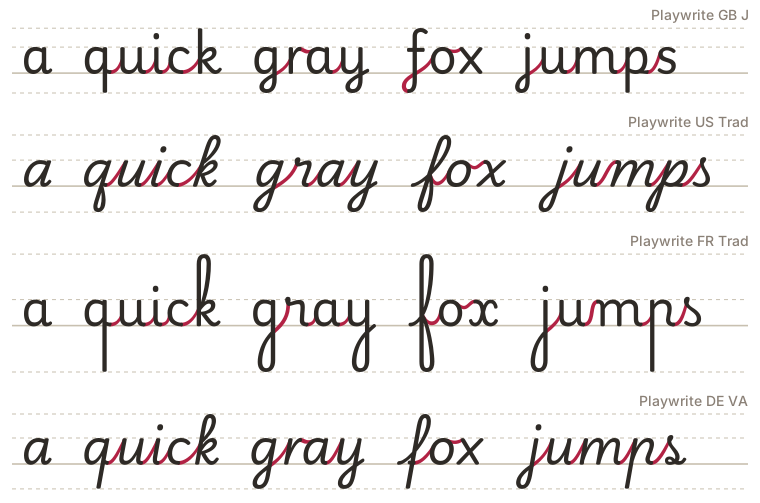
Best for: Learners who want to practise correct cursive joins, curriculum-aligned cursive instruction.
Fonts for Cursive Style Development
The following fonts are not recommended as learning models for cursive, but they are genuinely valuable for adult learners who are developing a personal handwriting style. The distinction matters.
Dancing Script, Pacifico, and Satisfy all have inconsistent joins, stylised loops, and letterforms that were drawn for visual appeal rather than for reproducibility by a moving hand. Practising against them as a beginner will build habits that are difficult to unlearn. But for an adult who already writes joined handwriting and wants to develop more character and flow, studying these fonts for their slant, their rhythm, and their overall sense of movement is a legitimate and useful exercise.
Sacramento, Great Vibes, and Pinyon Script sit even further along the style-inspiration spectrum. The thick-thin stroke contrast they display is produced by a broad-nib pen, which means replicating them exactly with a standard ballpoint or gel pen is not realistic. But the qualities worth studying, including the forward lean, the relationship between ascenders and descenders, and the sense of flow through a word, can absolutely be absorbed and adapted into everyday handwriting.
The most productive approach for this audience is to use a simpler font like Edu NSW ACT Cursive for the drilling work, and to use the more elaborate fonts as reference material for the style you are working toward.
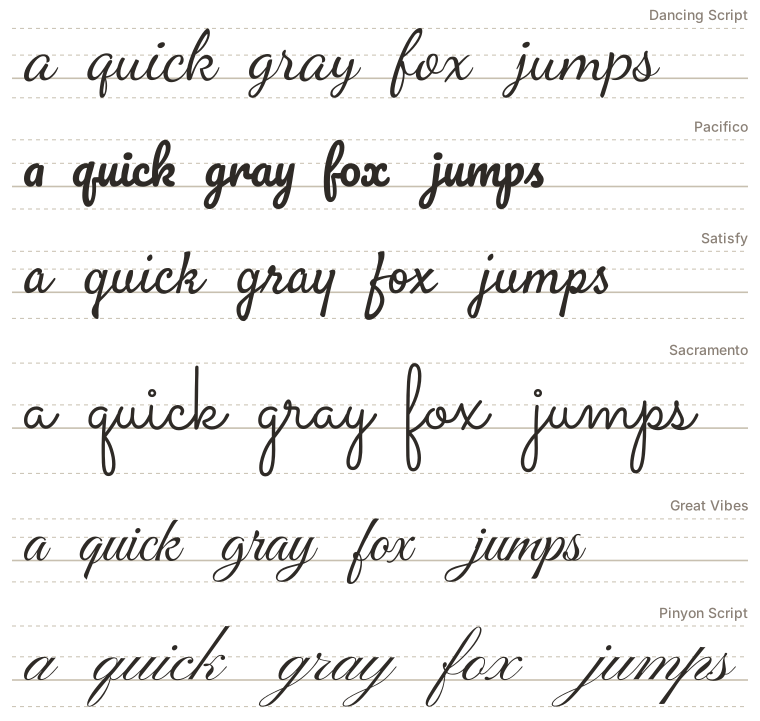
Best for: Adults developing personal cursive style. Not suitable as learning models for beginners.
Fonts to Approach with Caution
A few additional categories are worth being aware of before building practice sheets around them.
Fonts that look handwritten but use two-storey letterforms. If the lowercase a and g use the typographic double-storey forms, the font was designed for reading, not for modelling handwriting. It will teach the wrong formation for two of the most common letters in the alphabet.
Distressed or textured fonts. Some handwriting fonts include deliberate roughness or texture to simulate a natural hand. This roughness is visually appealing but misleading as a practice model, because it teaches the learner to expect imperfection in places where a real hand would produce a clean stroke.
Fonts with visible irregularity between repeated letters. If the letter e looks slightly different every time it appears, the font was designed to feel authentic rather than to serve as a consistent model. Authenticity and pedagogical usefulness are not the same thing.
All-caps or single-case fonts. Fonts that lack a complete lower and uppercase set are not usable for full practice sheets, even if the available glyphs look excellent.
Using Google Fonts in the Worksheet Generator
Every Google Font can be loaded directly into the worksheet generator. Type the name of the font into the font field, set your line style and content, and the sheet will preview in that font before you print.
Line spacing is worth adjusting when switching fonts. A font with a large x-height like Andika needs less vertical space between lines than a font with prominent ascenders and descenders. The generator allows you to set this manually, and a quick print test on a single sheet before printing a full set is always worth doing.
A few font-specific notes. Dancing Script and Satisfy both have prominent descenders on letters like g, j, and y, so tighter line spacing can cause those strokes to run into the line below. ABeeZee and Andika are the most forgiving at default settings and rarely need adjustment.
A Note on Font Licensing
For personal use or a single classroom, font licensing is rarely something you need to think about. All the fonts in this guide are available under the Open Font Licence, which allows free use including in printed materials.
If you are creating worksheets for commercial distribution, such as selling printable packs, it is worth verifying the licence of any font you use before distributing at scale. Most Open Font Licence fonts permit commercial use, but the terms vary slightly between fonts and it takes only a moment to check. The licence file is included in the font download from Google Fonts, or you can find the details on the font's page in the Google Fonts library.