Print vs cursive handwriting - which should you learn?
Most people learned one and have opinions about the other. Print writers often think of cursive as a decorative skill they never needed. Cursive writers sometimes treat print as something they left behind in primary school. Neither view is quite right, and neither style is objectively better than the other.
What they are is different, in specific and measurable ways. This article goes through those differences clearly so you can make a sensible decision about which one to develop, or whether to develop both.
What the terms actually mean
Print handwriting, sometimes called manuscript or block letters, is the style in which each letter is formed separately, with the pen lifting between letters and often between strokes within a single letter. The letterforms closely resemble the typefaces used in books and on screens, which is why children learn it first.
Cursive is the style in which letters within a word are connected by continuous strokes, so the pen moves across the page with fewer lifts. It typically involves entry and exit strokes on each letter that facilitate the joins, and in most styles the letters lean slightly to the right.
Between the two sits pre-cursive, which a number of school schemes teach from the very start: separate letters, like print, but each one already ending in the small exit flick a cursive letter needs. When joining is introduced later, the joins grow out of strokes the child already makes, so the move to cursive is a short step rather than a new alphabet.
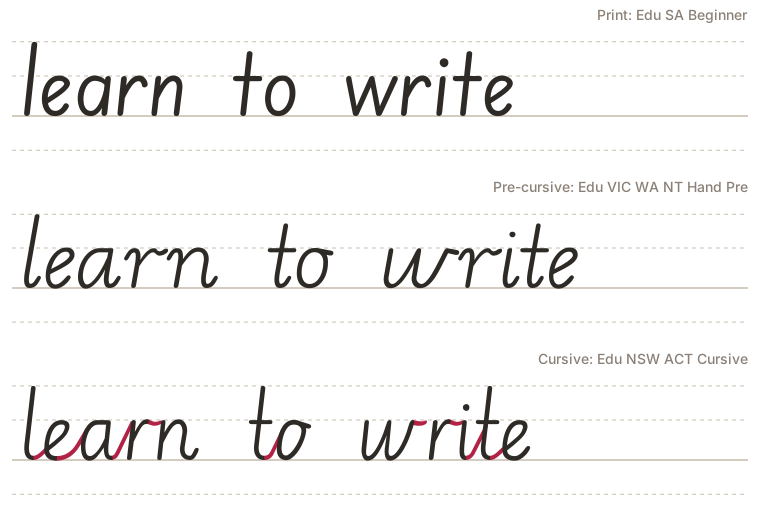
Italic is worth mentioning as a third category: a style that sits between the two, with letter forms closer to print but with optional joins and a consistent forward lean. Some people find it the most practical compromise, and it has a significant following among calligraphers and educators.
Speed
This is the question most people care about first, and the answer is more nuanced than either side tends to admit.
Fluent cursive is faster than print for most people. The reason is straightforward: lifting the pen between every letter takes time, and eliminating most of those lifts saves it. Studies comparing the two consistently find that fluent cursive writers produce more words per minute than print writers of equivalent overall ability.
The important word is fluent. Cursive that has not reached fluency is not faster than print. In fact it is often slower, because the writer is consciously managing joins rather than producing them automatically. The speed advantage of cursive is real, but it only arrives after several months of consistent practice.
For note-taking in particular, fluent cursive has a practical edge. Lectures and meetings do not slow down to accommodate your writing speed, and every second per word matters when you are trying to keep up. Many people who switch to cursive for note-taking report that they capture significantly more.
That said, the speed difference between a well-developed print hand and fluent cursive is smaller than popular belief suggests. A print writer who has worked on their speed can close much of the gap. Speed alone is not a strong enough reason to learn cursive if you have no other motivation to.
Legibility
Print is more immediately legible to more people, including the person who wrote it.
The letterforms in print are closer to the ones readers encounter in type, which means there is no translation step between seeing the letter and recognizing it. Cursive requires familiarity: a fluent cursive a looks quite different from a printed a, and someone who has never learned to read cursive can genuinely struggle with it.
For writing that will be read by others, particularly people who may not be comfortable with cursive, print is the safer choice. Forms, labels, addresses, anything where legibility to a stranger matters: print is less likely to cause problems.
For personal writing, notes, journals, anything where only you will read it, legibility is whatever works for you. Some people find their own cursive perfectly readable. Others find that writing fast in cursive produces something they cannot decipher the next day. Honest self-assessment is more useful here than generalizations.
Legibility in cursive also degrades faster under speed and fatigue than print does. Print letters have more visual separation between them, so even a tired or rushed print hand tends to remain parseable. Cursive relies on joins and flow, and when those break down the letters can merge in ways that are genuinely difficult to read back.
Learning curve
Print is easier to learn from scratch, which is why it is taught first to children.
The letters are simpler, the strokes are fewer per letter, and there is no join system to master on top of the letter forms. A child can produce recognizable print letters within a few sessions. Recognizable cursive takes considerably longer.
For adults learning a style from scratch, the gap is smaller. Adults learn by deliberate analysis as well as repetition, which accelerates the process. An adult learning print from scratch can reach a confident hand within a few weeks. An adult learning cursive from scratch can reach a legible hand within six to eight weeks, and a hand they are genuinely pleased with within three to four months.
For adults improving an existing hand rather than learning from scratch, print is generally faster to improve because the letter forms are already partially established. Cursive improvement requires building joins on top of letter forms, which adds a layer of complexity.
Which is better for children
Children learn print first because it maps onto the letter shapes they see in books, which supports early reading. Most educational approaches introduce cursive somewhere between ages seven and nine, once print formation is solid and fine motor control has developed enough. How the two styles relate, and how rough the transition between them is, varies by teaching system; our comparison of the major handwriting curricula goes through the options.
There is ongoing debate in educational circles about whether cursive should be taught at all, given that most adult writing is now done on keyboards. The practical answer is that both skills are useful for different purposes, and a child who learns both has more options than one who learns only one.
If a child is struggling with print handwriting, introducing cursive before the print is solid tends to compound the difficulties rather than resolve them. Solid print first is the right sequence.
Which is better for adults
It depends entirely on what you want from your handwriting.
If your goal is fast, practical note-taking and you are willing to put in the practice time, cursive is worth learning. The speed advantage is real once fluency arrives, and the process of learning it also tends to improve your overall understanding of letterforms and hand control.
If your goal is clear, reliable handwriting that anyone can read without effort, a well-developed print hand is entirely sufficient and arguably more practical for most adult purposes.
If your goal is a handwriting style you find satisfying and beautiful, that is a matter of personal taste. Some people love the flow of cursive. Others find a well-formed print hand more aesthetically appealing. Neither preference is wrong.
Many adults end up developing a hybrid style without deliberately choosing to: print letters with some joins borrowed from cursive, producing something faster than pure print and more legible than rushed cursive. This is a completely reasonable outcome and worth mentioning as an option rather than a compromise.
A direct answer
For speed: cursive, once fluent.
For legibility to others: print.
For ease of learning: print.
For note-taking: cursive if you are willing to invest the practice time, print if you are not.
For personal satisfaction: whichever one you find beautiful to look at and pleasant to produce.
If you can only learn one, learn print well. If you already write print and want to develop a second skill, cursive is a worthwhile investment. If you want something in between that you can develop more quickly than full cursive, look into italic.