English handwriting for ESL learners - how the writing systems differ
If you learned to write in another script first, English handwriting is not a beginner's task for you, whatever the worksheets aimed at five-year-olds might suggest. You already control a pen. You already have years of trained, precise hand movements. What you are actually doing is retraining specific habits, and which habits need retraining depends entirely on which script trained them.
This is why generic advice so often misses. A writer coming from Arabic and a writer coming from Chinese arrive at English handwriting with almost opposite strengths and difficulties. This guide goes through what English asks of the hand, and then looks script by script at where the real work lies for each background.
One reassurance before starting: an accent in handwriting, like an accent in speech, is not a fault. The goal is writing that is clear, comfortable, and quick enough for real life. Character is allowed to remain.
What English handwriting actually asks for
Every script makes its own demands, and English makes a specific set that is worth seeing plainly before comparing it to anything else.
- Direction: left to right, top to bottom, with spaces between words.
- Two cases: every letter has an uppercase and a lowercase form, and the pairs are often unrelated shapes. A and a share a name and nothing else.
- A proportion system: lowercase letters live in a band called the x-height, some reach up above it (b, d, h, k, l, t), some reach down below the baseline (g, j, p, q, y), and the contrast between these zones is what makes English writing readable at a glance.
- Separated letters, at least in print: each letter is a self-contained shape with space around it, and print is the standard style in modern English life. Cursive exists but is optional.
- A steady baseline: letters sit on an invisible line, and writing that drifts off it reads as untidy even when every letter is correct.
Most of the difficulty ESL learners meet is one of these five demands conflicting with a habit their first script installed. So the useful question is never how do I fix my handwriting, but which of these five is my script arguing with.
Coming from Arabic
Arabic and English handwriting are almost mirror images, and not only in direction.
Direction is the obvious retraining: years of right-to-left movement, with strokes pulled leftward, now reversed. The hand adapts faster than most learners expect, but early on it shows up as cramped letter spacing on the left side of the page and strokes that feel more natural pulled than pushed. Be patient with it and keep the paper angle comfortable rather than forcing the page straight.
The deeper differences are structural. Arabic is naturally cursive: letters connect, and each letter changes shape depending on its position in the word. From that starting point, English print can feel strangely disconnected, a row of isolated shapes where your instinct expects flow. Many Arabic-background writers actually find English cursive more intuitive than print for exactly this reason, but print is what English daily life mostly runs on, so it deserves the practice time even when it feels unnatural.
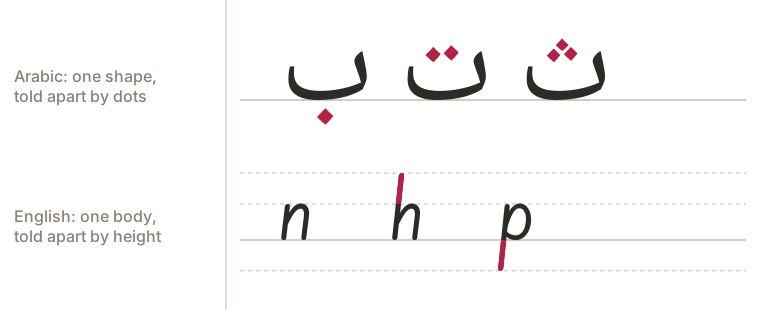
Arabic also has no letter case. The English case system is pure new learning, and it is worth treating the pairs as vocabulary: study A with a, G with g, learn which pairs are related shapes and which are strangers. And where Arabic distinguishes many letters by dots above and below a shared base shape, English distinguishes letters by the ascender and descender zones. That proportion system, tall letters genuinely tall, tails genuinely below the line, is usually the single highest-value thing an Arabic-background writer can practise, and four-line guide paper makes it concrete.
Coming from Chinese
If your first script is Chinese, you arrive with an advantage most learners lack: exceptional stroke control, trained by years of precise character writing. The pen obeys you. What needs retraining is the frame around the strokes.
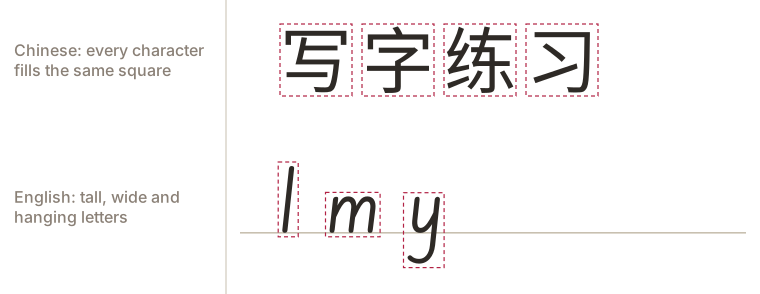
Chinese characters live in uniform invisible squares. Every character, however complex, occupies the same size box, and evenness of those boxes is a mark of good writing. English works on the opposite principle: letters are deliberately unequal. An l is tall and thin, an m is low and wide, a y hangs below the line. The most common signature of Chinese-background English handwriting is letters normalised toward equal height and width, which makes writing slightly harder to read because English readers navigate by the tall letters and tails. The fix is direct: practise on four-line guides and exaggerate the zones for a while. Make ascenders touch the top line and descenders touch the bottom one until unequal starts to feel correct.
Spacing follows the same logic. Chinese spaces characters evenly and marks no word boundaries; English clumps letters tightly into words and then separates the words clearly. The rhythm to build is tight inside, open between: letters within a word almost touching, and a gap about the width of a letter o between words.
Stroke order, so central to Chinese, matters far less in English. There are conventional formation patterns for each letter, and they are worth learning because they make writing faster and smoother, but no one will ever judge your letters by the order the strokes were made. That particular discipline can relax.
Coming from Cyrillic
Cyrillic-background writers have the shortest road. The scripts are cousins, the pen skills transfer almost completely, and English print usually arrives with little trouble.
There are two genuine trouble spots. The first is the false friends: letters that exist in both alphabets with different values, like В, Н, Р, С, and У. These cause more reading confusion than writing confusion, but occasionally a Cyrillic letterform leaks into an English word, especially when writing quickly.
The second is bigger, and it concerns cursive. Russian cursive is a highly developed system with its own forms, and several of them look like different English letters entirely: the Russian cursive т comes out looking like an English m, и like u, п like n, and д like a g or a script d. A fluent Russian cursive hand writing English at speed can produce words that an English reader honestly cannot parse. If this is you, the practical advice is simple: treat English cursive as a new system rather than adapting the one you have, or stay with print, which is fully acceptable in English at any age and in any setting. Our beginner's cursive guide starts from zero, which is the right place to start even when your hand thinks it already knows.
Coming from other scripts
The same analysis extends to any background once you know which of the five demands to check.
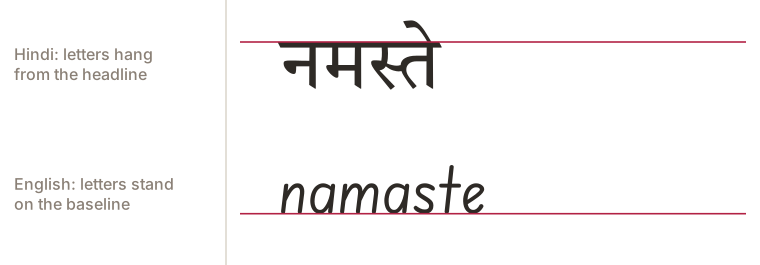
Writers of Devanagari and related scripts hang letters from a headline, the horizontal stroke running along the top of every word. English inverts this: letters stand on a baseline instead. The instinct to align the tops of letters rather than their bottoms is the habit to watch, and baseline-focused guide paper addresses it directly.
Hebrew shares Arabic's right-to-left direction and lack of case, without the connectedness, so the case system and direction are the work. Korean writers come from Hangul blocks and meet the same uniform-size instinct as Chinese writers, in milder form. Thai writers already know a baseline but come from a script without spaces between words, so English word spacing needs deliberate attention. And writers from scripts without case, which is most of the world's scripts, should expect the uppercase-lowercase system to take real study time. Case is the single most widely shared challenge among ESL learners, because so few other writing systems have anything like it.
A practice approach that respects what you already know
You are not a child learning to write, and your practice should not pretend you are. A focused adult approach looks like this.
- Start with print, not cursive. It is the standard style of forms, notes, and everyday English writing, and its separated letters give you clean feedback on each shape.
- Learn lowercase first. Around nineteen of every twenty letters you write in normal English text are lowercase. Capitals can follow once the lowercase shapes are settled.
- Use four-line guide paper from the beginning. The proportion system is English handwriting's backbone, and guides make it visible instead of guessable. Once your zones are steady, step down to ordinary lines.
- Give the universal confusables a little deliberate attention: b and d, p and q mirror each other and trip up learners from every background, including native ones.
- Practise with words you actually need. Copying your own vocabulary lists, your field's terminology, or sentences from your coursework trains handwriting and English at the same time, and it keeps practice from feeling like children's work.
Ten focused minutes a day moves faster than an occasional long session. Most adult learners see their English hand settle into something comfortable and clear within a couple of months of that rhythm.
Write your practice words large at first, around twice your normal size. Large writing exposes the proportions and shapes clearly, and errors you can see are errors you can fix. Normal size comes naturally once the shapes are right.
Sheets to start with
These printable sheets cover the foundations: letter formation with stroke guidance, tracing with space to copy, and blank four-line paper for the proportion work.

A–z Basic print with arrows
All 26 uppercase and lowercase print letters with arrows indicating stroke order, on four-line guides. Oversized letters, great for new learners of any age. One letter per row with tracing.

A–z Basic print with copy
All 26 uppercase and lowercase upright print letters on four-line guides. One letter per row with tracing followed by empty guided lines for copy practice.


Empty four-line
Empty page with only the 4 guide lines, for easy printing and copywork practice.
The script you grew up writing gave you control, patience, and a trained hand. English handwriting is not a replacement for any of that. It is one more system learning to live in the same hand, and with a clear view of where your script and English disagree, the work is smaller than it looks.